
10k vs 14k vs 18k Gold Chains: Choosing a Karat for Daily Wear
Karat is often read as a ranking, with a higher number assumed to be the better object. A chain worn against the skin every day tells a more useful story: alloy content shapes color, hardness, and how a piece ages, and the right choice depends less on the number than on how the chain will actually live on a wrist or collar.
Pure gold is soft, warm in tone, and rarely worn on its own for a piece meant to take daily handling. The karat figure describes how much of that pure metal remains once other elements are added for strength and color. An 18k chain is 75 percent gold; 14k is roughly 58 percent; 10k sits near 42 percent, the lowest purity that may still be called gold in many markets. The remaining fraction, the alloy, is where the practical differences begin.
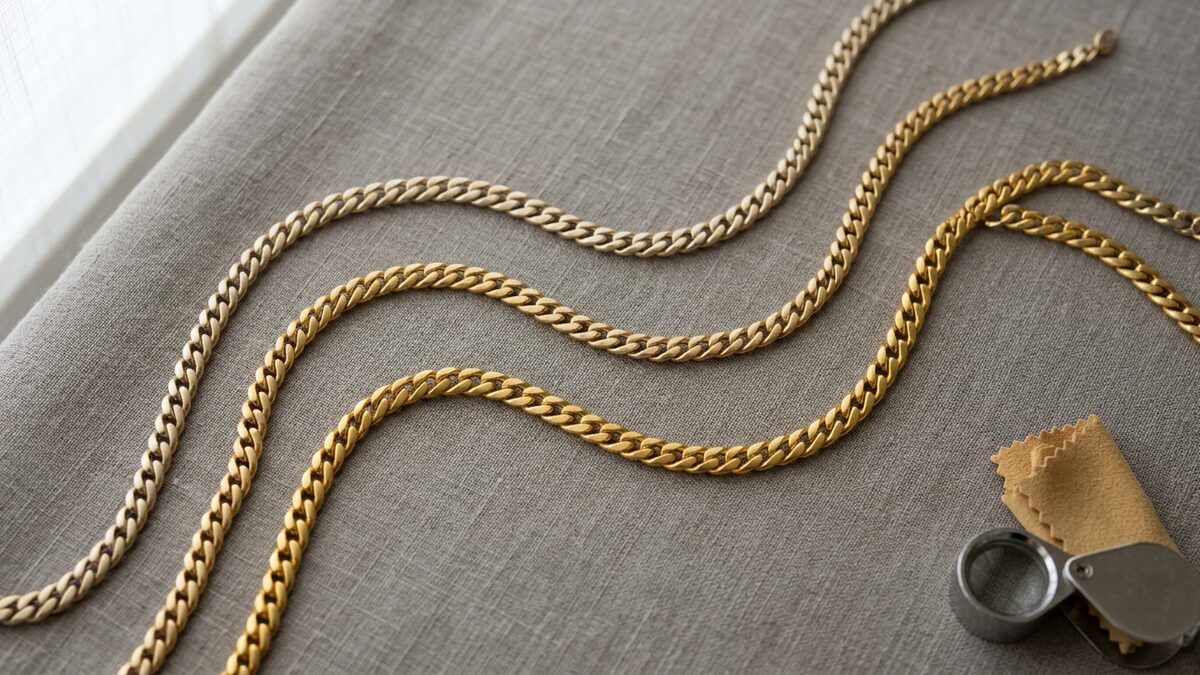
That alloy is usually some blend of copper, silver, zinc, and occasionally palladium or nickel. Copper pushes the color warmer and slightly red; silver and palladium cool it. Because 10k carries the most alloy, its hue is the most muted of the three, a softer yellow that some readers prefer and others find thin. The 18k chain, with three quarters pure metal, holds the deep, saturated yellow most people picture when they imagine gold. The 14k option lands between them, which is part of why it has become the quiet default for chains intended to be worn without much thought.
How Hardness and Alloy Content Shape Daily Wear
The same alloy that dilutes color also adds hardness. More alloy means a more scratch-resistant surface, so a 10k chain resists the small abrasions of keys, cuffs, and desks better than an 18k one of the same construction. For a piece worn continuously, this matters more than it first appears. Links rub against each other thousands of times a day, and softer metal burnishes and thins at the contact points over years.
This does not make higher purity fragile, only softer. An 18k chain develops a gentle patina and rounds at its edges sooner, which many wearers read as character rather than damage. A 14k chain holds its definition longer while keeping a recognizably rich color. The decision is less about durability in the dramatic sense and more about how a reader wants the surface to age: crisp and bright, or soft and worn-in.
Construction carries as much weight as karat here. A hollow link in any purity dents more readily than a solid one, and a tightly woven chain distributes stress better than a sparse one. A solid 14k chain in a dense weave will outlast a hollow 18k chain of greater nominal value, so the karat number should be read alongside how the object is actually built. Clasp quality and link gauge often decide a chain's life span before purity ever enters the conversation.
Matching Karat to How a Piece Will Be Worn
Skin chemistry and setting deserve a place in the choice. Higher alloy content means more reactive metals near the surface, so 10k and some 14k pieces are marginally more likely to interact with very acidic skin or to mark over long wear. Readers with sensitivity to nickel should ask after the specific alloy, since some white and lower-karat formulations use it while others substitute palladium. A nickel-free alloy can usually be requested when it matters.
For a chain that rarely leaves the body, showering, sleeping, and working included, the harder lower karats reward that life with fewer visible marks. For a piece worn deliberately and set aside, where color and presence carry the appeal, 18k earns its place. The 14k middle continues to suit readers who want one chain to do both jobs without compromise feeling like a sacrifice.
Value follows purity in raw metal terms, though resale rarely returns the full premium of the higher karats, so buying 18k purely as a store of worth is an imperfect strategy. A more honest frame is to treat the number as a description of behavior. An 18k chain is the warmest in color and the softest in hand. A 10k chain is the most muted and the most resistant to marking. A 14k chain compromises on neither in a way most wearers will notice day to day.
Seen that way, there is no single best karat, only a closer or looser match to a way of wearing. A reader who handles a piece roughly and wants it to look the same in a decade is well served by a lower, harder karat in a solid weave. A reader drawn to deep color, willing to let a surface soften over time, will find that higher purity rewards the patience. The most useful question is not which number is highest, but which set of trade-offs a chain will be asked to carry once it is on and forgotten.