
Box Chain vs Venetian Chain: Geometry, Drape, and Daily Wear
At a glance, a box chain and a Venetian chain look like cousins: both build a clean rectilinear line from a sequence of square links, both catch light in flat planes rather than the lively flicker of a curb or rope. Spend an afternoon with each, though, and the resemblance ends. The two construction families articulate differently, drape differently, and read differently against the skin. For anyone choosing a chain to live with every day, the distinction is worth understanding.
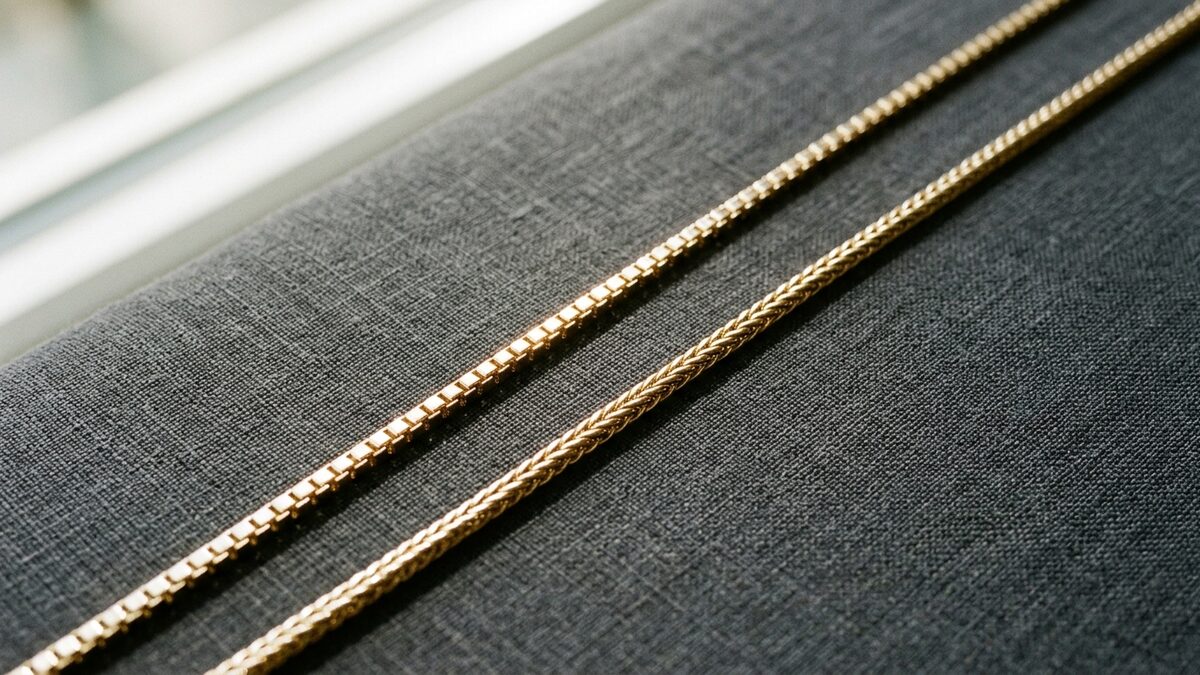
The box chain is the more familiar of the two. Each link is a small open cube formed from a single loop of wire bent into a square, then closed and threaded through its neighbor at a right angle. The result is a continuous column of cubes, each one rotated ninety degrees from the last. Because the links are hollow and the connection points sit at the corners, a box chain has a noticeable degree of play. It bends in any direction with equal willingness and falls into soft curves rather than sharp angles when it settles around the neck.
The Venetian chain, sometimes called a Venetian box or Venetian link, takes the same square silhouette and tightens it. The links are shorter along the long axis, often solid or partially filled rather than fully open, and they nest more closely against one another. The effect is a chain that reads as a single continuous bar of metal from a short distance, with the link divisions only visible on close inspection. Articulation is reduced; the chain still flexes, but it resists bending and prefers to hang in a straighter, more deliberate line.
Light behavior follows directly from these structural differences. A box chain presents four small flat surfaces per link, and because each link rotates against its neighbor, the planes sit at varied angles to any incoming light source. The chain therefore shows a gentle, broken sparkle: small highlights that shift as the wearer moves but never combine into a single bright line. It reads as quietly active, alive without being loud.
A Venetian chain, with its denser link spacing and longer reflective planes, behaves more like a polished bar. Light strikes a continuous surface and returns it as a sustained highlight rather than a scatter of small ones. From across a room, a Venetian chain reads as a single bright stroke against the skin. The effect is more architectural, more graphic, and arguably more formal. Where the box chain whispers, the Venetian states.
How each chain sits across a day of wear
Drape is where the two diverge most clearly in lived experience. A box chain, with its high articulation, conforms to whatever it sits against. Worn under a shirt collar, it follows the curve of the neck and disappears into the contour. Worn over a sweater or against bare skin, it pools loosely at the base of the throat and shifts with every movement. Wearers who prefer a chain that feels barely present tend to gravitate toward the box for this reason; it asks nothing of the body and conforms to whatever the body does.
The Venetian chain holds its line. Because the links resist bending along their long axis, the chain wants to hang straight down from its highest point rather than follow a curve. Worn at a length that clears the collarbones, it presents as a defined vertical against the chest rather than a soft loop around the neck. This is part of its appeal: a Venetian chain reads as a deliberate choice, a piece of jewelry that has been worn rather than simply put on. It also pairs more confidently with a pendant of any meaningful weight, because the chain itself provides a stable line for the pendant to hang from rather than shifting under the load.
Comfort over a long day depends on the wearer's tolerance for either behavior. The box chain's articulation means it occasionally catches on fabric, particularly knits and anything with a loose weave, because the open corners of each link can hook a thread. The Venetian chain, with its tighter construction, slides more cleanly against clothing and rarely snags. On the other hand, the Venetian chain's straighter hang means it sits in a more fixed position against the skin, which some wearers find slightly less comfortable in warm weather; the box chain's tendency to shift means it never sits in exactly the same spot for long.
Choosing between them
For a first serious chain meant to be worn daily and read as quiet rather than decorative, the box construction is usually the safer choice. It is forgiving across outfits, comfortable under collars, and reads as understated even in heavier gauges. For a chain that will be visible and is meant to anchor a look rather than recede into it, the Venetian construction earns its keep. It is a more sculptural object, more aware of itself, and rewards being worn where it can be seen.
Gauge interacts with both choices in important ways. A box chain at a fine gauge, say one to one and a half millimeters, reads almost as a line of light. The same construction at three millimeters or above takes on real presence and begins to feel substantial in the hand. A Venetian chain scales differently; even at fine gauges it retains its graphic quality, and at heavier gauges it can read as quite formal, almost masculine in its architectural confidence. Anyone choosing between the two should handle examples in person where possible, because the way a chain feels in the hand and falls across the fingers tells far more than any photograph.
Both families have earned their place in the jewelry vocabulary by being honest about what they are: clean, geometric, and unornamented. The choice between them is less about quality and more about the relationship the wearer wants with the object. One adapts; the other declares. Both reward attention.