
Byzantine Chain Construction Explained: Why the Weave Holds Its Form
Among classical chain weaves, the Byzantine occupies a particular place. It is denser than a wheat, more sculptural than a rope, and visually more complex than a Cuban link, yet it achieves all of this without bulk. The reason is geometric: each link sits at a fixed angle to its neighbors, and the whole structure resolves into a fluid, four-sided rope that bends without kinking and drapes without twisting.
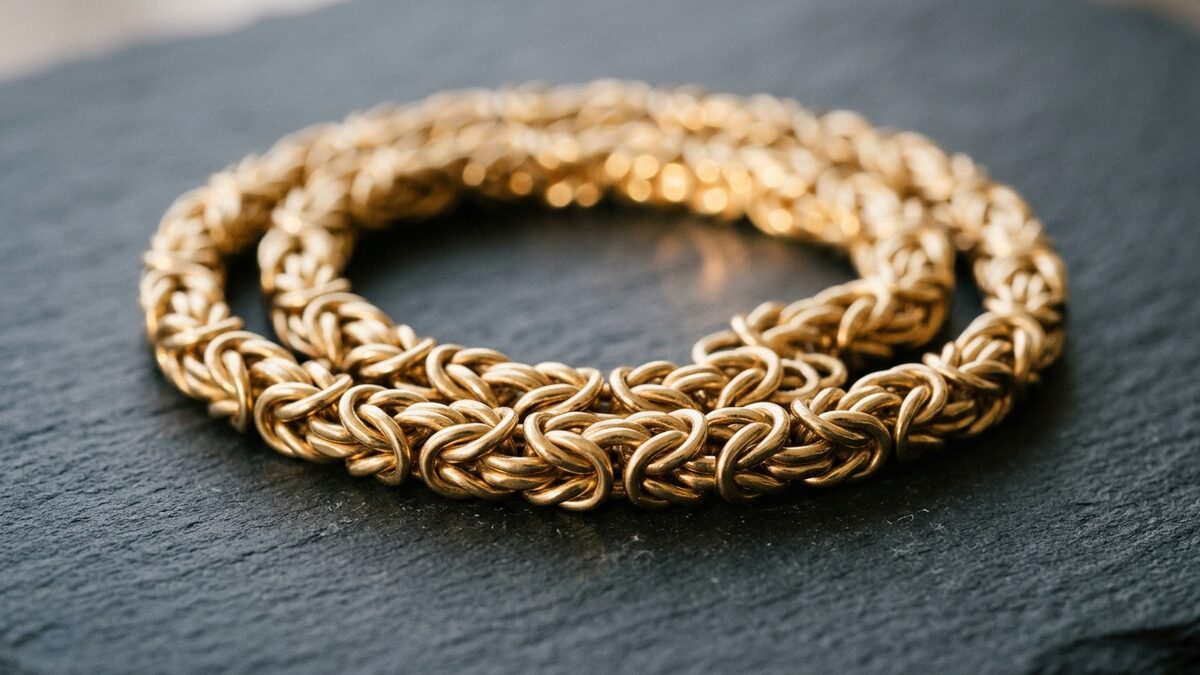
The Byzantine weave is built from a single component, the simple oval jump ring, repeated and oriented in a precise pattern. What distinguishes it from chains that use the same component, like the standard cable or rolo, is the way the rings are grouped and pivoted. Pairs of rings sit parallel to one another, and adjacent pairs are rotated ninety degrees. Then a connecting ring passes through both pairs at the transition point, locking each group into the next. The result is a chain that reads as a continuous braided column rather than a string of discrete links.
This grouping pattern is the source of the weave's defining quality, which is the way it holds its form. A simple cable chain has one degree of rotational freedom at every link, which is why cables tangle so readily. The Byzantine effectively constrains that freedom. Each link is held by two neighbors on one axis and two more on a perpendicular axis, so the chain can flex along its length but cannot pivot freely at any single point. Lay a Byzantine chain on a flat surface and it stays where you put it. Pick it up by one end and it falls into a clean line rather than coiling on itself.
The construction also explains the chain's substantial visual weight at modest actual weight. Because the links interlock into a four-sided rope, the chain presents the same silhouette from every viewing angle. A figaro or a Cuban link has a clear front and back; a Byzantine reads identically whether it sits flat or rolls slightly on the wearer. For a piece intended to be worn high on the collarbone or layered with other chains, this rotational symmetry is genuinely useful. The chain does not need to be adjusted to look correct.
What Separates Italian Hand-Finished Work From Machine-Made Byzantine
Most Byzantine chains on the market today are assembled by machine, and a well-made machine Byzantine is a perfectly respectable object. The distinction worth understanding is one of finish rather than construction. Machine-assembled chains use rings cut from drawn wire, and the cut points leave a small seam where the ring closes. On a budget chain this seam is visible under magnification and sometimes to the naked eye, particularly at the connecting transition rings where stress concentrates. The seams catch light differently from the surrounding metal, which produces a slightly broken, granular look along the length of the chain.
Italian workshops that produce Byzantine chains for the higher end of the market handle this differently. The rings are still drawn and cut, but each closure is then soldered shut and the joint is filed or polished flush with the ring's profile. Once every ring is closed, the entire chain is tumbled or hand-polished so that the metal reads as a single continuous surface. Held under raking light, a well-finished Italian Byzantine shows a clean, uninterrupted braid where the eye cannot pick out individual junctions. This is the quality that buyers are paying for at the upper price tiers, and it is the quality that separates a chain that looks expensive from one that looks merely well-engineered.
Two other markers of careful finishing reward close inspection. The first is the consistency of ring size and ring spacing along the full length. Hand-finished chains are usually inspected and corrected after assembly, so the rhythm of the weave is uniform from clasp to clasp. Cheaper chains often show subtle variation in link diameter or pitch, particularly toward the ends where the chain meets the findings. The second is the transition into the clasp. A premium chain integrates the clasp end caps into the weave so that the diameter of the chain and the diameter of the cap match, and the joint sits flush. Lower-end work often shows a step where the chain narrows abruptly to meet a smaller fitting.
What to Examine When Comparing Byzantine Chains
When evaluating a Byzantine chain in person, three things deserve attention. The first is the weight relative to the apparent thickness. Because the weave is dense, a Byzantine should feel heavier in the hand than a hollow rope or a similarly diameter wheat. A chain that feels conspicuously light for its width is either hollow-built, which is acceptable if disclosed and priced accordingly, or thinly drawn. The second is how the chain hangs. Held by the clasp, a well-made Byzantine should fall in a clean vertical line with no twisting, kinking, or curling. Any tendency to spiral on itself indicates inconsistency in the ring orientation during assembly.
The third is the behavior at the clasp end. Work the lobster or box clasp through several full cycles. The clasp should engage smoothly without binding, the end caps should not rotate independently of the chain, and the transition from chain to clasp should not show any flex that the rest of the chain does not also show. Stiffness at the very end of an otherwise fluid chain usually signals an over-soldered transition that has stiffened the last few links, which over time becomes a stress point.
The Byzantine sits in a useful position within the broader chain-construction taxonomy. It is more visually substantial than the wheat, more structured than the rope, more refined than the figaro, and less aggressively masculine than the Cuban link. For a wearer who wants the presence of a heavier chain without the directional rigidity of a Cuban, or the textural softness of a rope without its tendency to twist, the Byzantine resolves the trade-off cleanly. The geometry does the work, and the finish reveals the maker.