
Cable Chain vs Rolo Chain: How Two Classic Links Differ
The cable and the rolo are the two chains most people already own without knowing their names. Both are built from round links, both read as quiet and versatile, yet they behave differently once they sit against the skin. Understanding that difference is the shortest route to choosing well.
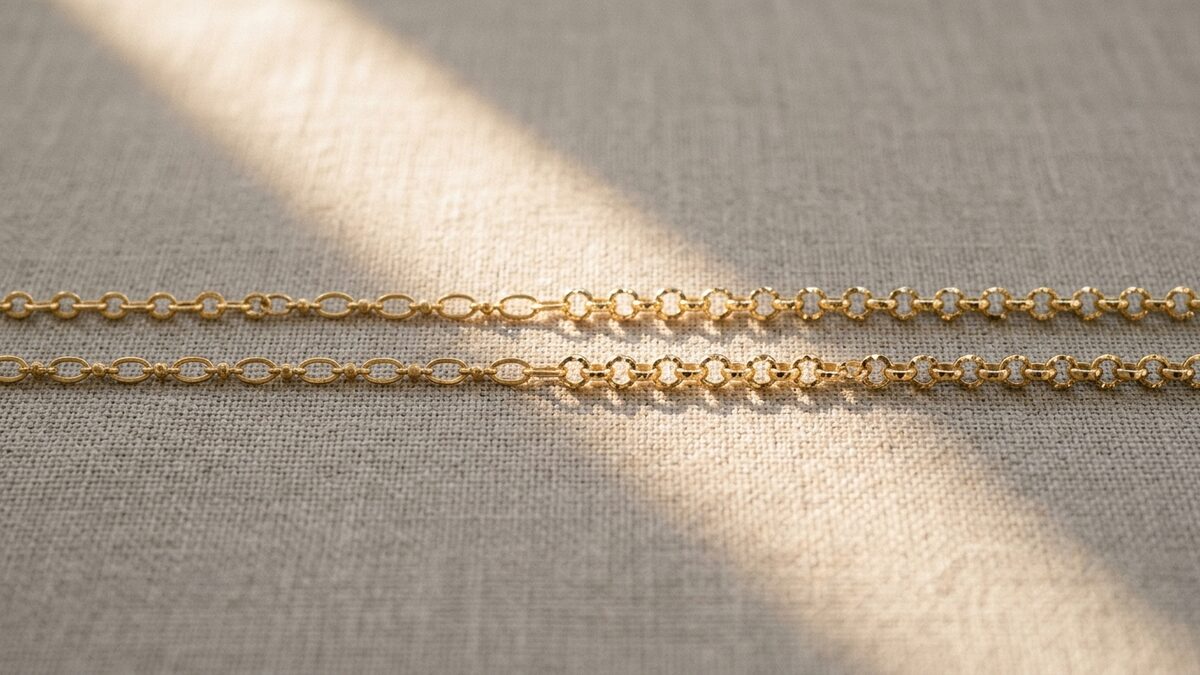
At first glance the cable and the rolo look like siblings, and in a sense they are. Each is assembled from simple loops soldered closed and joined in sequence, a construction so old it predates almost every decorative variation that followed. What separates them is the cross-section of the wire and the way each link meets the next. Those two small facts govern everything else: how the chain moves, how it reflects light, how it wears over years of daily handling.
A cable link is typically drawn from round or slightly oval wire and set so that alternating links sit at right angles to one another. The result is an even, ladder-like rhythm that most people picture when they hear the word chain. A rolo link, by contrast, is usually a rounder, more symmetrical loop, often with a flattened or diamond-cut face, and the links lie in a more uniform plane. The rolo tends to read as fuller and slightly more architectural, while the cable reads as lean and classical.
How link geometry shapes the way each chain catches light
Light is where the two designs part company most clearly. Because a cable chain alternates the orientation of its links, it presents a series of small, angled surfaces that scatter light in several directions at once. The effect is soft and continuous, a low shimmer that follows the curve of the neck without drawing attention to any single point. This is part of why a fine cable disappears so easily under a collar and why it partners so gracefully with a pendant; it supports the object hanging from it rather than competing with it.
The rolo behaves more deliberately. Its broader, flatter faces, especially when diamond-cut, act like a run of tiny mirrors set in a common plane. Instead of scattering, the chain returns light in brighter, more defined flashes as it moves. Worn alone, a rolo can carry a look on its own terms, which is why it is often chosen as a standalone piece rather than a mount for a charm. Neither approach is superior; they simply answer different questions. If the goal is a discreet frame for something else, the cable wins on restraint. If the chain itself is meant to be the object, the rolo has more to say.
Proportion changes the equation too. A very thin rolo loses much of its reflective advantage and starts to behave like a cable, while a heavy cable in bold gauge takes on some of the presence people associate with a rolo. The categories blur at the extremes, which is worth remembering when comparing pieces only by name.
Drape, weight, and the durability of the solder joints
On the neck, the cable generally offers the more fluid drape. Its alternating links create natural articulation points, so the chain follows movement closely and settles into a clean line. The rolo, with its more uniform links, tends to sit with a touch more structure. Some wearers read that as substance and others as stiffness; both readings are fair, and both depend heavily on gauge and length rather than on the pattern alone.
Weight tracks with wire thickness more than with style, yet the rolo often feels marginally heavier at a given length because its links enclose more metal per unit. That density is part of its appeal for anyone who likes to feel a piece as well as see it. A cable of equal length in the same gauge usually feels lighter and more forgettable in the best sense, the kind of thing that stays on from morning to night.
Durability is the quiet decider. Every soldered link is a potential weak point, and here the round profiles of both chains work in their favor: stress spreads around a curve rather than concentrating at a corner. The cable's main vulnerability is the thin single-link connection, which can open if the chain is yanked or caught. The rolo's fuller links distribute strain over a broader joint and often prove a little more forgiving under rough handling, though a well-made cable in a sensible gauge will outlast most wearers without complaint. In both cases the honest variables are metal purity, wire thickness, and the quality of the solder, not the pattern printed on the label.
So which everyday role suits each? A cable earns its keep as the reliable companion to a pendant and as the near-invisible everyday piece that pairs with anything. A rolo makes sense when the chain is meant to stand alone, to add a little more heft and a little more brightness, and to hold its shape as part of a considered look. Many wearers end up owning both and reaching for each without much thought, which is perhaps the clearest sign that both have earned their long tenure.
Choose by intention rather than by name. Decide whether you want a frame or an object, a whisper or a statement, then match the gauge and length to how you actually live. The two links have survived centuries precisely because each answers a real question, and the better you know the question, the more obvious the answer becomes.