
Curb Chain vs Cuban Link: How the Two Differ
The Cuban link is often described as a descendant of the curb chain, and the lineage is real. Both begin from the same interlocking oval, both lie flat against the skin, and both have anchored menswear for the better part of a century. Yet the objects behave differently in the hand, and understanding why begins with the shape of a single link.
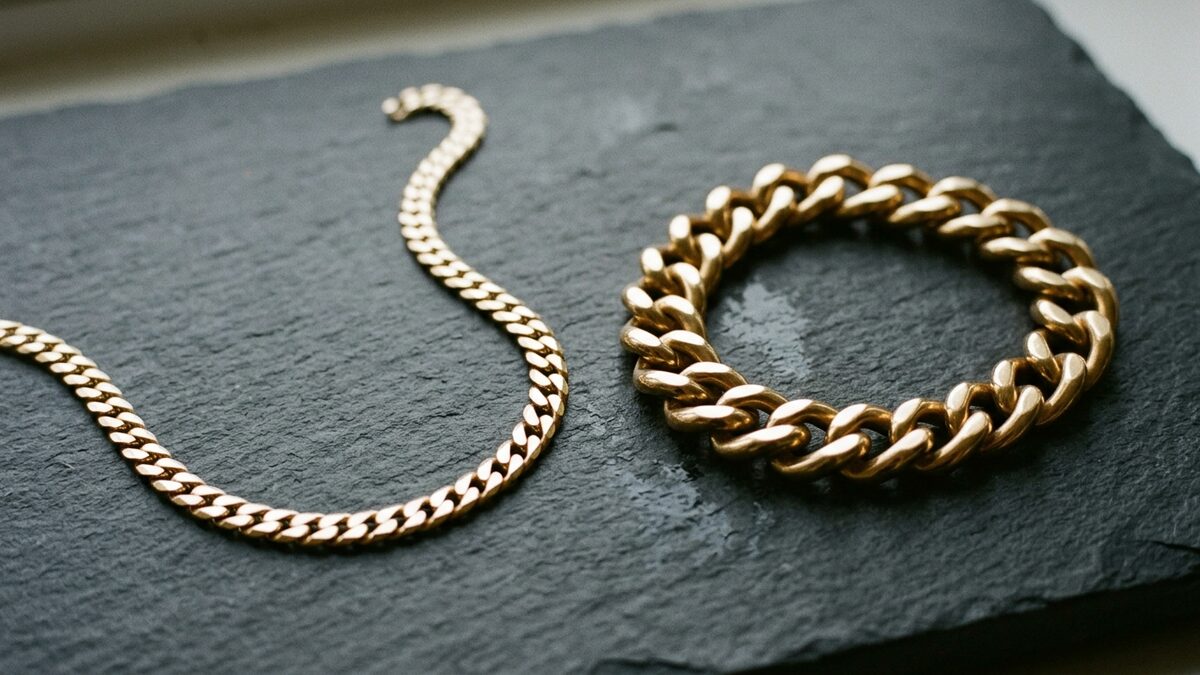
A curb chain is built from oval links that have been twisted and then compressed until they sit in one plane. That flattening is the defining act. It allows each link to nest against its neighbours so the chain reads as a continuous flat ribbon rather than a loose string of loops. The result is a piece that follows the collarbone closely and reflects light in even, repeating planes.
The Cuban link starts from the same idea and pushes it further. The links are thicker in cross-section, the ovals are rounded rather than lean, and the interlock is tightened so each link locks firmly into the one before it. Where a curb chain feels like a flat tape, a Cuban link feels like a solid, articulated column of gold. The two are relatives, but one is drawn and elegant while the other is dense and deliberate.
Link geometry and the role of diamond-cut faceting
The clearest way to tell the families apart is to look at the edge of the link. On a traditional curb chain, the twisted oval is flattened enough that its outer faces catch light in narrow bands. Many curb chains are then diamond-cut, a finishing step in which a precise tool shaves tiny facets into the metal. Those facets act like small mirrors, so the chain throws off a brighter, more granular sparkle than a plain polished surface would. The faceting is subtle and reads best in motion.
A Cuban link is usually left with broader, smoother faces. Because the links are heavier and the interlock is tighter, the appeal comes from mass and from the clean geometry of the joins rather than from cut-in sparkle. Some Cuban pieces are diamond-cut as well, but the effect is different: on such a substantial surface, faceting reads as a controlled shimmer across a wide plane instead of the fine glitter you see along a slim curb. If you place the two side by side, the curb chain scatters light and the Cuban link holds it.
Geometry also governs flexibility. The thin, well-flattened links of a curb chain articulate freely, so the chain pours over the fingers and settles quickly. A Cuban link, with its greater thickness, moves in firmer segments. It bends, but it does so with more resistance, and that resistance is part of what people are paying for. The stiffness signals density, and density signals gold.
Clasp choice tends to follow suit. Lighter curb chains often close with a simple lobster or spring-ring fitting that stays out of the way. Heavier Cuban pieces usually rely on a box clasp, sometimes reinforced with a safety catch, because the closure has to carry real weight without working itself open through the day.
Drape, gold weight, and how each wears
Drape is where the difference becomes something you feel rather than something you measure. A curb chain in a modest gauge traces the neck and disappears under a collar with ease. It is the quieter object, comfortable for daily wear and happy to sit alone or layered with a pendant. Because the links are flattened, the chain rarely twists or rides awkwardly, which is a large part of its long popularity.
A Cuban link asks for more presence. Even at a moderate width it announces itself, and as the gauge grows the piece becomes a genuine statement worn against bare skin or an open collar. The weight is not incidental; it is the point. A heavier chain sits with authority, warms against the body, and moves with a slow, satisfying swing that a lighter piece cannot reproduce.
Gold content shapes both the price and the character of each. The same design in 10-karat, 14-karat, or 18-karat gold will differ in colour saturation and in hardness. Lower-karat alloys are paler and harder, which suits a slim curb chain meant for constant use. Higher-karat gold is warmer and softer, and its richer tone flatters the broad faces of a Cuban link, though the softer metal benefits from more careful handling. Solid construction and hollow construction change the equation again: a hollow Cuban link can offer the visual scale of a heavy piece at a fraction of the weight, while a solid one delivers the full heft and the durability that comes with it.
For someone choosing between the two, the decision usually comes down to intent. A curb chain is the versatile classic, refined enough to read as jewellery and restrained enough to wear every day. A Cuban link is the bolder choice, an object meant to be seen and felt, rewarding those who want the reassuring weight of gold at the throat. Neither is a lesser version of the other; they are two answers to the same starting shape, separated by how far each one commits to mass.
Whichever you favour, examine the links closely before you buy. Even nesting, clean facet lines, a clasp that seats without play, and a clear karat stamp are the marks of honest work. Those details hold true across both families, and they are the surest guide to a chain that will wear well for years.