
Figaro Chain vs Cuban Link: How the Two Patterns Differ in Hand and Wear
Two patterns dominate the conversation when a buyer walks in asking for a first serious gold chain. The figaro, with its rhythmic three-and-one cadence inherited from mid-century Italian goldsmithing, and the cuban link, a heavier curb derivative whose tightly interlocked ovals have come to define a more contemporary visual language. Choosing between them is rarely a question of which is better. It is a question of which behaves the way the wearer wants it to behave, on the collarbone, under a shirt, in photographs, and across the years.
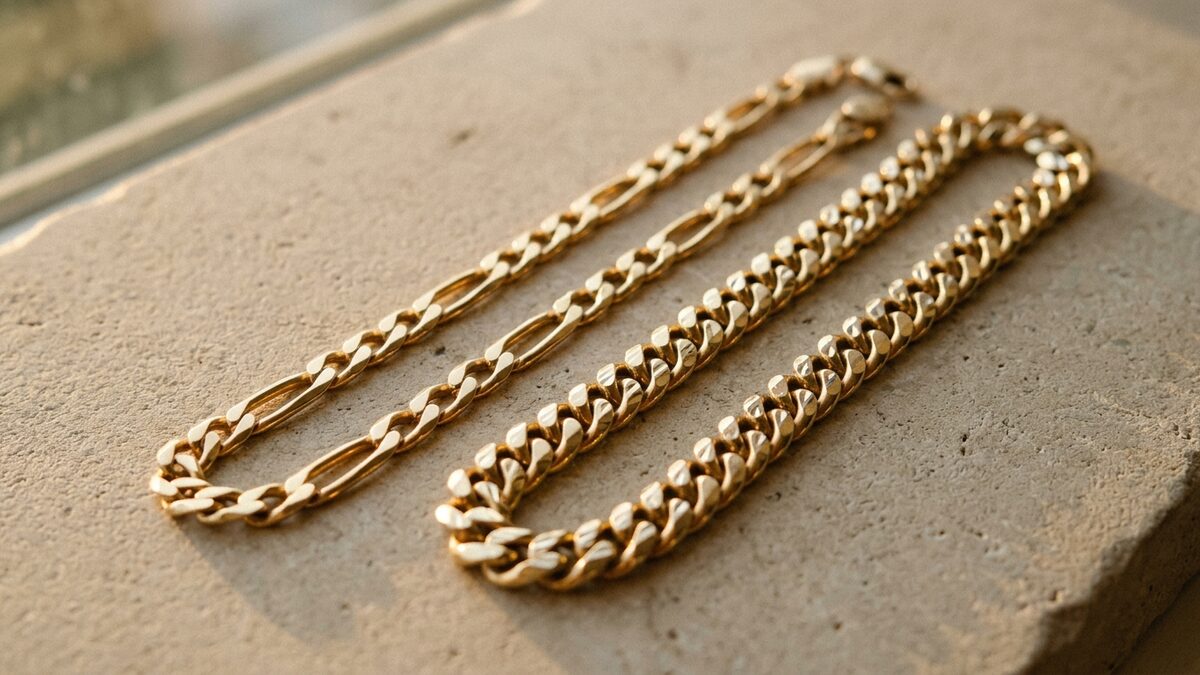
The figaro is built on alternation. Three short oval links, then one elongated link, repeating. The pattern was popularized in Italy in the mid-twentieth century and takes its name, by most accounts, from the operatic barber, a nod to the chain's lyrical, almost rhythmic visual structure. Held in the hand, a figaro feels lighter than its diameter suggests. The elongated links create small breaks in the chain's mass, which means a figaro of a given gram weight drapes longer and finer than a cuban of the same weight.
The cuban link works on a different principle. Each link is a flattened oval, interlocked tightly with its neighbors so that the chain reads as a continuous, almost solid band. The links are usually diamond-cut on the top surface and polished on the sides, which produces the pattern's signature compressed shimmer. Where the figaro breathes, the cuban presses. A cuban chain of meaningful gauge sits on the collarbone with weight, and that weight is part of what the pattern is communicating.
Drape, gauge, and how each pattern reads at length
A figaro at four millimeters wide reads as a refined, dressed chain. It can disappear under a collar or sit cleanly above a crewneck without dominating the frame. The same chain at seven or eight millimeters takes on more presence but retains the openness of the pattern, which keeps it from feeling heavy. Figaro tends to flatter longer lengths, twenty-two to twenty-six inches, where the alternating links can develop their cadence across the chest.
A cuban link behaves differently as gauge increases. At four millimeters, a cuban reads as a clean, unfussy chain, but the pattern's character only really emerges past six millimeters, where the interlock becomes visually dense enough to catch light as a single surface. A cuban at eight to twelve millimeters at twenty inches sits short and weighty, framing the base of the neck. Longer cubans exist, but the pattern's intent is generally compression rather than extension.
This matters for the buyer thinking about a single chain that has to do several jobs. A figaro is more forgiving across contexts. It can be worn with tailoring, with a t-shirt, layered with a pendant, and it photographs cleanly because the eye can read its structure. A cuban asks the rest of the outfit to accommodate it. That is not a flaw, it is the pattern's premise.
Daily wear, aging, and what each pattern forgives
Both patterns are durable when made correctly, which means solid links rather than hollow, properly soldered closures, and a clasp matched in gauge to the chain itself. Hollow versions of either pattern exist and have their place, but for a chain intended as a long-term object, solid construction is the relevant baseline. A solid figaro in eighteen-karat yellow holds its shape well over years of wear because the alternating link structure distributes stress across multiple geometries. The elongated links flex slightly, the short ovals hold tension, and the chain settles into a softened drape that many wearers come to prefer over the original out-of-the-box stiffness.
A cuban ages differently. Because the links are interlocked tightly, a well-made cuban develops a polished sheen along the contact points where the links rub against one another. Over time, this gives the chain a worn-in luster that is difficult to replicate artificially. The diamond-cut top surfaces soften slightly, which most wearers read as patina rather than wear. The risk with a cuban is at the clasp and at the first link adjacent to it, which carry disproportionate stress; a properly specified box clasp with a safety latch is not optional on a heavier cuban.
Figaro chains forgive layering. Their open structure means a second chain, or a pendant on a finer chain, sits cleanly alongside without tangling. Cuban links resist layering. The pattern's density and weight tend to dominate anything worn with it, and finer chains layered over a heavy cuban can scratch against the diamond-cut surfaces. A buyer who anticipates layering should weight the decision toward figaro, or accept that the cuban will be the solo piece.
Photographs, light, and the long view
Photography reveals the patterns' different intentions. A figaro reads well in soft, directional light because the alternating links create their own rhythm of highlight and shadow. The chain looks like itself in a phone snapshot and in a more deliberate image. A cuban depends more heavily on light. In flat lighting it can read as a uniform band without distinction; in directional light, particularly raking light from one side, the diamond-cut surfaces ignite and the pattern's compressed geometry becomes visible. Wearers who care about how a chain looks in casual photographs often gravitate toward figaro for this reason.
Across years of wear, the question of which pattern was the right choice usually answers itself. Figaro buyers tend to wear their chains continuously, swapping pendants, layering occasionally, treating the chain as a baseline object. Cuban buyers tend to wear their chains as statement pieces, taken off and placed in a tray at the end of the day, considered. Neither relationship is more correct. They are different relationships with different objects, and the patterns were designed, over decades of refinement in Italian and later American workshops, to support exactly those different relationships.
For a first serious gold chain, the honest guidance is this. If the buyer wants a chain that disappears into daily life and rewards long ownership with a softened, lived-in character, figaro is the more flexible choice. If the buyer wants a chain that announces itself, that frames the neck with weight, and that develops its character through compression and polish, cuban is the pattern that was built for that intention. The gold itself, the karat, the workshop, the clasp, all of those decisions sit downstream of the pattern. Pattern is the first decision, because pattern determines how the object will live with the wearer.