
Franco Chain vs Cuban Link: How the Two Compare
The Franco and the Cuban link sit in the same corner of the solid-gold cabinet, and they are mistaken for one another more often than any other pair of chain styles. Both are worn close to the collar, both read as a continuous band of metal, and both carry real weight. Yet the two are built on different principles, and the distinction announces itself the moment either is lifted into the hand.
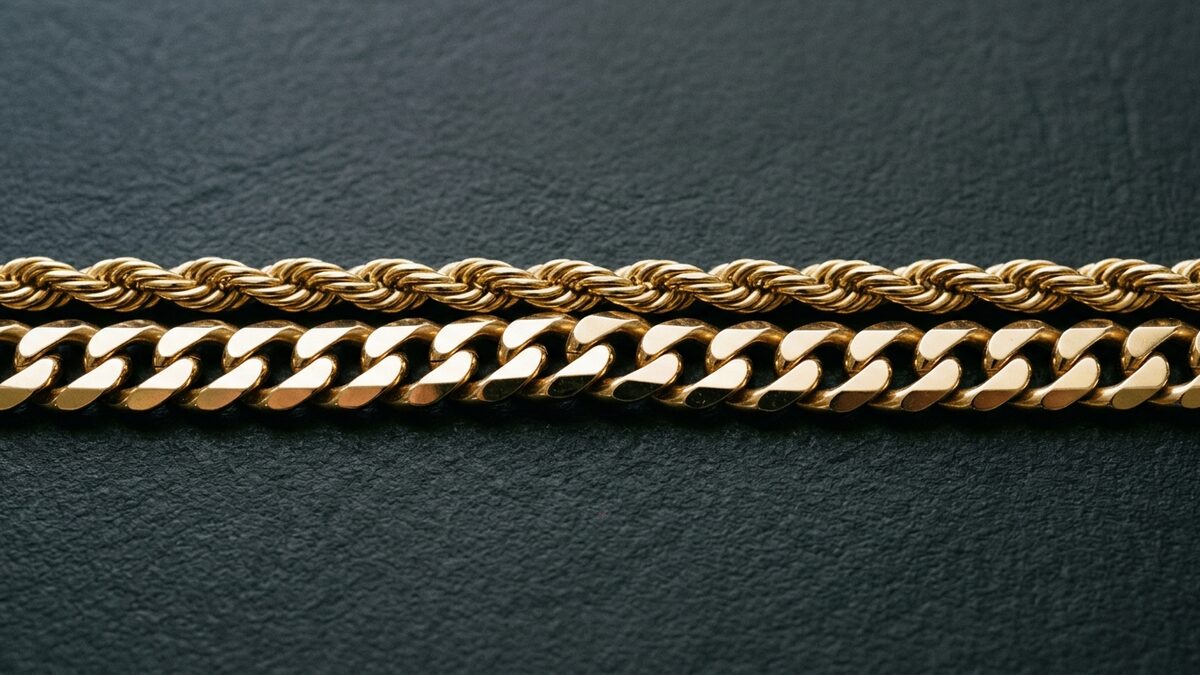
Two constructions that share a silhouette but little else
A Franco is assembled from four-sided links, each a small square-profile loop that seats into the one before it. The result is a dense, close-packed rope with a faint V-groove tracing its length. There is very little visible gap between the components; the eye reads the surface as one object rather than a sequence of parts. That density is the defining trait, and it is why a Franco of modest width can still feel substantial across the fingers.
A Cuban link takes a different route. Its ancestor is the curb chain, in which oval links are twisted and then compressed so that each one lies flat against its neighbor. The individual links stay legible: you can count them, follow the interlock, and see how the piece is put together. The face is wider and more open than a Franco of comparable weight, and the profile is lower against the skin. Where the Franco hides its structure, the Cuban displays it.
This is the first practical fork for anyone choosing between them. A Franco reads as a smooth, uniform column. A Cuban reads as an articulated series of interlocking segments. Neither is more correct; they are simply answering different questions about how a chain should present itself.
How each behaves in the hand and over time
Surface behavior follows directly from geometry. The tight seating of a Franco means it catches light along the whole run at once, producing an even sheen rather than a series of highlights. A Cuban, with its broader flat faces, tends to gather light in discrete points, so it flickers as it moves. In lower light the Franco holds a steadier presence, while the Cuban comes alive with motion. Collectors who prefer restraint often gravitate toward the former for exactly this reason.
Weight distribution differs as well. Because the Franco packs its mass into a narrow, continuous form, a given gram count feels concentrated and firm; the chain has less lateral play and drapes with a certain rigidity. A Cuban of the same weight spreads that mass over a wider face and a more open articulation, so it feels more fluid and settles into the collar with a softer line. Some readers describe the Franco as disciplined and the Cuban as relaxed, and the description holds up in practice.
Durability is where the comparison earns its keep. The dense interlock of a Franco leaves little room for a single link to twist or splay under stress, and the design is forgiving of everyday handling. Its vulnerability is the clasp and the transition points, as with most chains. A Cuban link, by contrast, relies on the integrity of each individual oval and, in better examples, on soldered joints that keep the links from opening. A well-made Cuban is exceptionally sturdy; a poorly finished one can loosen at the joints over years of wear. Construction quality matters more here than in the Franco, so the joins repay close inspection.
Wear over time also plays out differently at the surface. Solid gold is soft, and both styles will acquire fine marks with use. On a Franco, those marks distribute across a continuous surface and tend to read as a gentle, uniform patina. On a Cuban, the raised flat faces take the brunt of contact, so signs of wear concentrate there while the recessed joints stay cleaner. Many owners consider this a virtue: the piece records its own history in a way that feels earned rather than damaged.
There is a comfort dimension worth naming. The Franco's rigidity keeps it from tangling and lets it sit precisely where placed, which suits those who want a chain to hold its position through the day. The Cuban's flexibility makes it sit lower and move more with the body, which some find more natural against the skin. This is a matter of preference rather than merit, and it is best judged by handling both rather than by specification alone.
For the reader weighing the two, the decision tends to resolve along a single axis: whether the object should assert one uninterrupted line or a rhythm of visible links. A Franco favors quiet uniformity and a firm, concentrated feel. A Cuban favors articulation, motion, and a lower, more relaxed drape. Both are honest expressions of solid-gold craft, and both reward attention to weight, finish, and the quality of the clasp far more than to width alone. Handle each if you can, note how the surface answers the light, and let the object rather than the category make the final case.