
Hollow vs. Solid Gold Chains: When Each Makes Sense
Hollow chains cost less per piece and more per gram of actual gold — and they dent, kink, and return at higher rates. The decision between hollow and solid is not about quality in the abstract. It is about what your customer segment actually needs and how you price it.
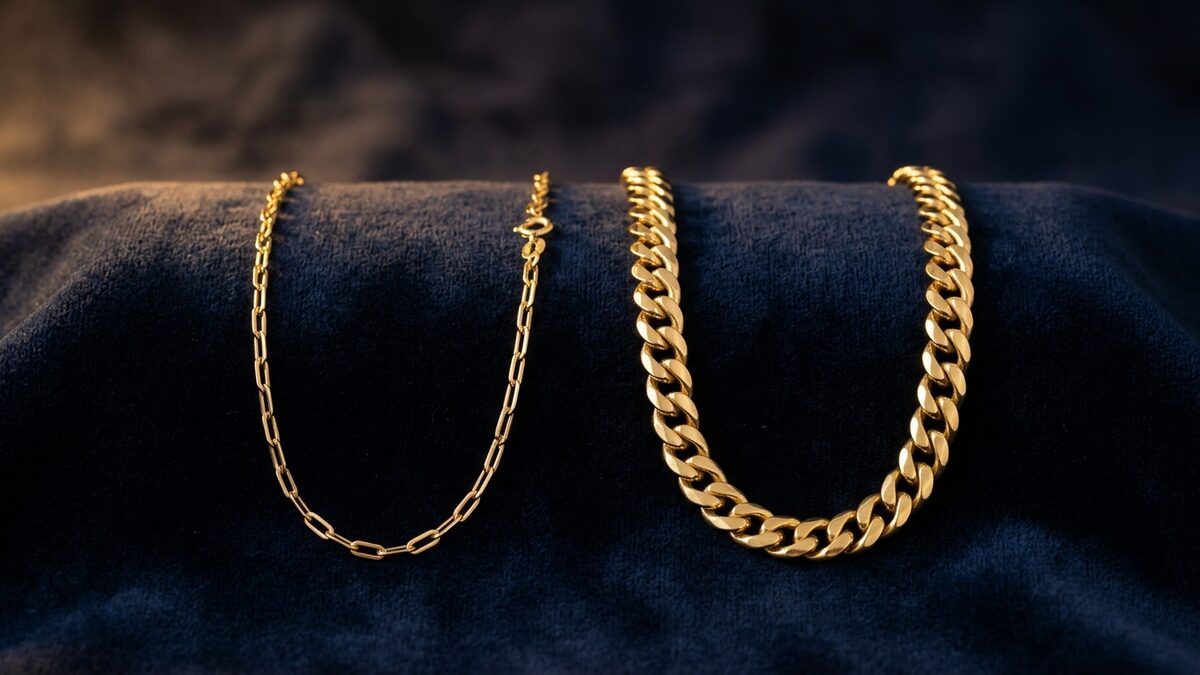
The construction difference, stated simply
A solid gold chain uses the full cross-section of gold in every link. A hollow chain uses a thin shell of gold around an air-filled center. Both are stamped 14K because the gold content of the shell is 58.5% fine gold — the stamp refers to alloy composition, not the overall gold content of the piece.
The consequence: a hollow 24-inch chain that looks identical to a solid 24-inch chain from the same distance can weigh less than half as much. A 2-gram hollow chain and a 5-gram solid chain of the same visible thickness are not interchangeable products. They serve different customers at different price points, and the failure modes are completely different.
The cost math
At current spot, 14K gold costs roughly $62–$68 per gram at wholesale depending on fabrication style and origin. A 2-gram hollow chain contains roughly 1.17 grams of pure gold, representing about $75–$80 in metal at current prices. A 5-gram solid chain of the same style contains about 2.93 grams of pure gold, representing about $188–$200 in metal.
The hollow chain's lower wholesale price reflects less gold, not cheaper production. In fact, hollow chain fabrication is more technically demanding than solid chain — the tube construction requires precision machinery and careful finishing to avoid visible seams. You are buying less gold, not less craft.
Where hollow chains make legitimate sense
Hollow construction exists for real reasons and serves real market segments:
- Entry price points. A customer with a $150 retail budget can buy a 24-inch hollow rope chain that looks the same as a solid chain at 6 feet. For the customer, the value is appearance at a price they can afford.
- Fashion chains with short expected life. Trend-driven styles that sell fast and get replaced in 18–24 months. The customer is not buying for heirloom durability — they are buying for the look this season.
- Large-diameter statement pieces. A 10mm solid Cuban link bracelet in 14K at 7 inches runs 35–45 grams. That is $2,200–$3,000 at the counter before any retail markup. Hollow construction brings that same visual presence to a $600 price point. Different product, different market.
Where hollow chains create problems
Three failure patterns repeat reliably:
- Denting and kinking. Hollow links crush under lateral pressure — a purse latch, a tight knot, a dog leash caught wrong. Solid links flex; hollow links deform. Once dented, a hollow chain is not economically repairable. This is the most common customer return scenario in the under-$200 chain segment.
- Clasp failure at the hollow-solid junction. The point where the hollow tube meets the lobster claw is a stress concentration. Lower-quality hollow chains fail here at higher rates than solid chains. The fix is a heavier clasp — but that defeats part of the cost savings.
- Customer perception mismatch. The customer who buys a hollow chain thinking they are getting solid value is a return waiting to happen. If you are not distinguishing hollow from solid clearly in your sell story, the mismatch surfaces as returns and complaints, not as customer education.
The sell-through difference: In OroJoy's trade data, solid chains in the 3–8 gram range have return rates under 2%. Comparable hollow chains run 6–9%. The price difference at wholesale is real, but the total cost of ownership — including returns, replacements, and customer friction — narrows significantly when you account for durability.
How to stock both intelligently
The right approach is not hollow or solid — it is knowing which customer you are selling to and having the right product for each. A general framework:
- Under $200 retail price point: hollow is appropriate if clearly labeled and sold as a fashion piece
- $200–$600 retail: mix, depending on style — hollow for large-visual-statement pieces, solid for everyday wear chains
- Above $600: solid strongly preferred; customers at this price point expect durability and notice when they do not get it
- Gift purchases: solid whenever possible — gifts get worn continuously and returned when they fail
What to tell a wholesale buyer who does not know the difference
The clearest explanation: "Hollow means the chain is priced lower because it contains less gold. It looks the same on the display but weighs half as much when you pick it up. Solid is heavier, higher gold content, and more durable for everyday wear. They serve different customers." That is the whole story. Most buyers will appreciate the directness — and it prevents the returns that come from customers who discover the difference after the purchase.