
Italian gold chain clasps explained: lobster, spring ring, and box clasps compared
On an Italian gold chain, the clasp is the most engineered component on the object. The links are repetitive geometry, drawn and soldered at scale; the clasp is a small mechanism that has to open, close, and survive several thousand cycles without distorting. Most buyers look at the chain and forget the joint. Looked at carefully, the clasp tells you more about the piece than the link pattern does.
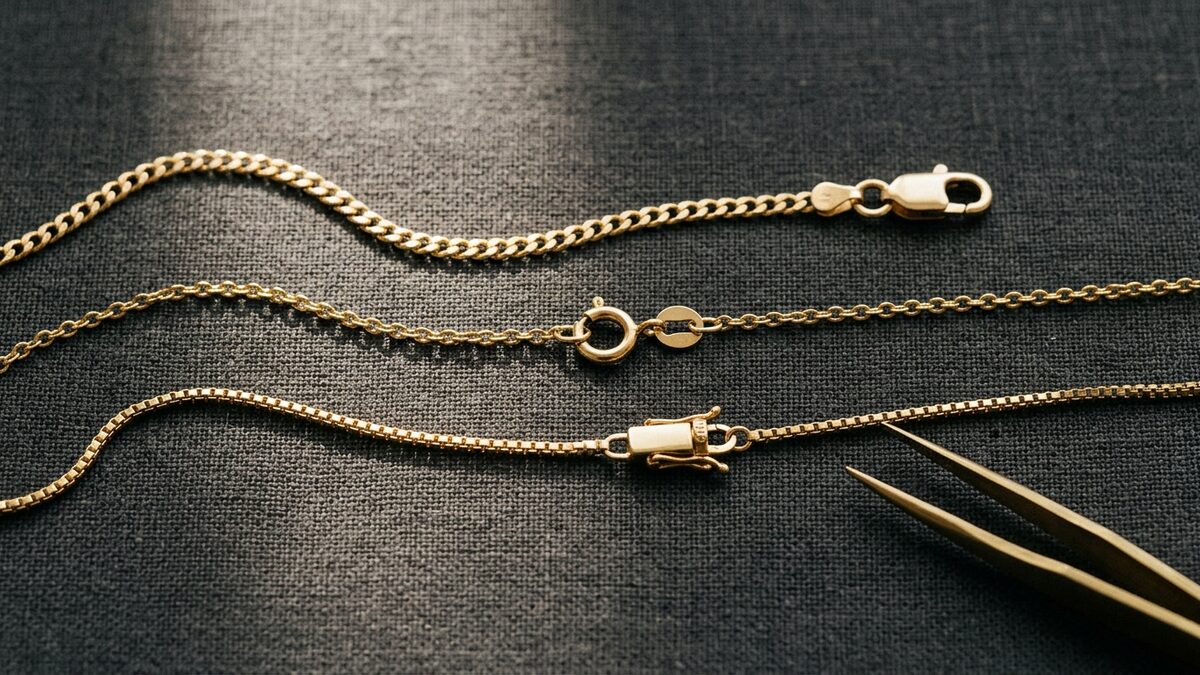
Three clasp types account for the overwhelming majority of Italian gold chains in circulation: the lobster claw, the spring ring, and the box clasp. Each has a specific feel in the hand, a sensible pairing range by chain weight, and a characteristic failure mode. Understanding the differences is less about preference and more about matching the closure to the chain it sits on.
The lobster claw is the workhorse. A spring-loaded lever pulls back a small gate, the open hook catches the end ring of the chain, and the spring snaps the gate closed. The geometry is self-locking under tension: the harder a chain pulls on the clasp, the more firmly the gate is held shut. On Italian production, lobster claws are typically machined or cast in 14k or 18k to match the chain, with a stamped spring inside the body. The lever should travel smoothly with light thumb pressure and return crisply when released. A sluggish return is the earliest sign of spring fatigue, and on a quality clasp it appears only after years of daily wear.
Lobster claws pair comfortably with chain weights from about three grams upward. On lighter chains, the clasp can look proportionally heavy and sit slightly low on the back of the neck. On heavier rope, figaro, and curb chains in the 10 to 30 gram range, the lobster is the default for good reason: it opens one-handed, holds securely under the weight of a pendant, and the visible joint is small enough to disappear into the link pattern.
The spring ring is the older design. A circular body houses a hooked gate that retracts when a small tab is pulled back along a track, exposing an opening for the end ring of the chain. It is mechanically simpler than a lobster and, when made well in solid gold, beautifully unobtrusive. The visible profile is a clean circle that reads as part of the chain itself rather than as added hardware.
Two things matter when assessing a spring ring. The first is the gauge of the wire forming the ring body; thin wire flexes over time and eventually allows the gate to misalign with the track, at which point the clasp will not close reliably. The second is the action of the tab: it should slide with a firm, defined resistance and snap closed without the user having to guide it. Spring rings suit lighter chains, typically in the one to eight gram range. On heavier pieces, the small tab becomes awkward to operate, and the proportionally lighter ring body is asked to carry more force than its geometry was designed for.
The box clasp and what to inspect at the joint
The box clasp is the most considered of the three. A folded leaf of metal, often tensioned, is inserted into a hollow box and held in place by friction against the box walls. A small safety catch, usually a figure-eight loop or a hinged tongue, secures the assembly against accidental opening. On Italian gold work, the box clasp is the traditional closure for heavier curb chains, herringbone, and the flat woven chains where a lobster claw would interrupt the pattern.
What distinguishes a good box clasp is the fit between the leaf and the box. The leaf should enter with light pressure and seat with a clear, audible click. There should be no lateral play once seated; if the assembled clasp can be wiggled side to side, the tension on the leaf has relaxed and the closure is no longer reliable. The safety catch is not decorative. On a flat chain worn against the skin, the primary clasp can be worked open by ordinary movement over a long day, and the safety is what keeps the chain on the neck.
Box clasps pair with chain weights from roughly eight grams upward, and on the heaviest pieces, above 25 grams, they are often the only sensible option. The closure sits flush with the chain pattern, which preserves the visual continuity that defines a well-made Italian flat chain. The trade-off is that box clasps require slightly more care in operation: two hands, attention to the orientation of the leaf, and a habit of confirming the safety has engaged.
What to inspect where the clasp meets the chain
The clasp itself is rarely the point of failure on a quality Italian chain. The joint where the clasp attaches to the chain is. This joint is usually a small soldered jump ring or a stamped end cap, and it carries the full tension of the chain against the clasp body. On lighter chains it is often the lightest gauge metal in the entire piece.
Three things to check on a chain you are considering. First, lift the clasp end and look at the jump ring under good light: the solder seam should be invisible or, at worst, visible only as a faint line, and the ring should be perfectly round, not pulled into an oval. Second, gently flex the clasp away from the chain; there should be no play at the joint, and certainly no audible click. Third, if the chain has an end cap rather than a jump ring, the cap should sit tight against the last link with no gap, and the inside of the cap should show clean solder, not visible flux residue or porosity.
The clasp is small and easy to overlook, but it is where the chain's engineering is most concentrated. A piece that feels right at the joint will generally feel right everywhere else.