
Mariner Chain vs Anchor Chain: Nautical Link Construction Compared
Mariner and anchor chains share a nautical lineage, yet they behave like entirely different objects on the body. One reads as flat and architectural, the other as rounded and fluid, and the distinction begins with a single structural detail at the center of each link.
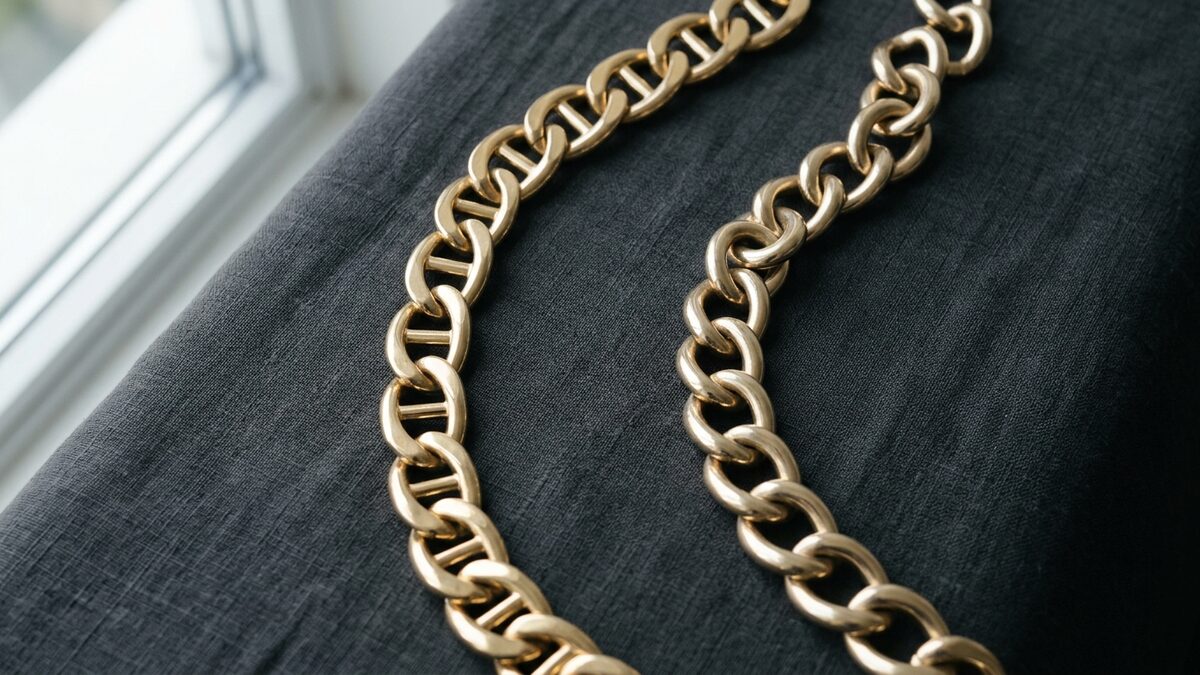
The mariner link is defined by a horizontal bar that bisects an elongated oval. That bar, sometimes called a stud or crossbar, is the same feature that gives a ship's anchor chain its strength at scale, and it is what jewelers borrowed when they translated the form into precious metal. The result is a link that lies flat, with each segment locking into the next at a consistent angle. Anchor chains, by contrast, use an open oval without the central bar. The links alternate orientation, one vertical, one horizontal, producing a rounded profile that catches light from multiple planes rather than reflecting it in broad sheets.
Drape behavior follows directly from this geometry. A mariner chain falls in a single confident line, hugging the curve of the neck and resting against the collarbone with a flat presence. The crossbars create a subtle ladder pattern that the eye reads as deliberate and industrial in the best sense. Anchor chains move differently. Because each link rotates ninety degrees from its neighbor, the chain has a more organic flow, settling into soft curves rather than crisp lines. Worn loose, an anchor chain shifts and resettles with movement; a mariner chain holds its position.
At equivalent gauges the two styles carry weight differently. A 4mm mariner link distributes its mass across the flat face of each segment, which makes the chain feel substantial without reading as heavy. The same 4mm in an anchor link concentrates weight at the rounded edges, producing a chain that feels denser in the hand and more present on the neck. Buyers cross-shopping the two at the same width often describe the mariner as the more wearable of the two for daily use, while the anchor reads as the more sculptural piece for occasions when the chain itself is meant to be the focal point.
How each style holds polish and ages on the body
Polish retention is where the geometries diverge most clearly. Mariner links present broad, flat surfaces that act almost like small mirrors. A high polish on these faces is striking when new, with reflections that travel cleanly across the length of the chain. Those same flat surfaces, however, show micro-scratches more readily, and the patina that develops over years of wear is a soft, brushed quality that some collectors prize and others find diminishing. Owners who prefer a chain to look as it did the day they bought it tend to choose a matte or satin finish on mariner links, which absorbs surface marks rather than displaying them.
Anchor chains age more forgivingly. The curved surfaces scatter light rather than reflecting it in continuous planes, so individual scratches blend into the overall texture of the metal. A polished anchor chain worn daily for a decade often looks remarkably close to its original state, with only a slight softening of the highest points where the links contact each other. This durability of appearance is one reason the style has remained a staple in heritage collections and family pieces meant to pass between generations.
How each style sits against the collarbone is worth considering carefully. A mariner chain tends to ride higher on the chest because its flat construction prevents the chain from settling into the natural hollow at the base of the neck. For men with broader frames the effect is balanced and architectural. For women, particularly in shorter lengths, the same property creates a clean horizontal line that pairs well with open necklines. Anchor chains drop lower at the same length, following the contour of the body more closely. The rounded links allow the chain to nest into the collarbone hollow, which can be flattering on narrower frames but may look less defined on broader ones.
Pendant pairing is the final practical consideration. Mariner chains accept pendants with smaller bails most gracefully, because the flat link profile slides cleanly through narrow openings. A pendant designed for a curb or rope chain may not fit a mariner link at all without modification, and forcing the issue stresses the bail at exactly the point most prone to failure. Anchor chains accept a wider range of bail sizes, including the larger oval bails common to vintage pendants and religious medals. For collectors who rotate pendants frequently, the anchor style offers more flexibility; for those who wear a single pendant continuously, the mariner offers a cleaner integration between chain and ornament.
For everyday wear, a 2.5mm to 3.5mm gauge in either style sits comfortably under a shirt collar and reads as refined rather than declarative. For statement layering or solo wear at the open neck, gauges of 4.5mm and above give either chain the visual weight to anchor an outfit without supporting elements. The choice between mariner and anchor at that point is less about specification than about which geometry the wearer wants resting against the skin every day, a question the body answers more reliably than the eye.