
Rope Chain Construction and Why It Drapes the Way It Does
A rope chain is one of the few chain styles that reads as jewelry even from across a room. The reason is not the metal alone; it is the geometry. Dozens of small diamond-cut segments, set on a continuous helix, behave like a moving prism on the collarbone. Understanding that construction explains almost everything about how a rope chain wears, ages, and occasionally fails.
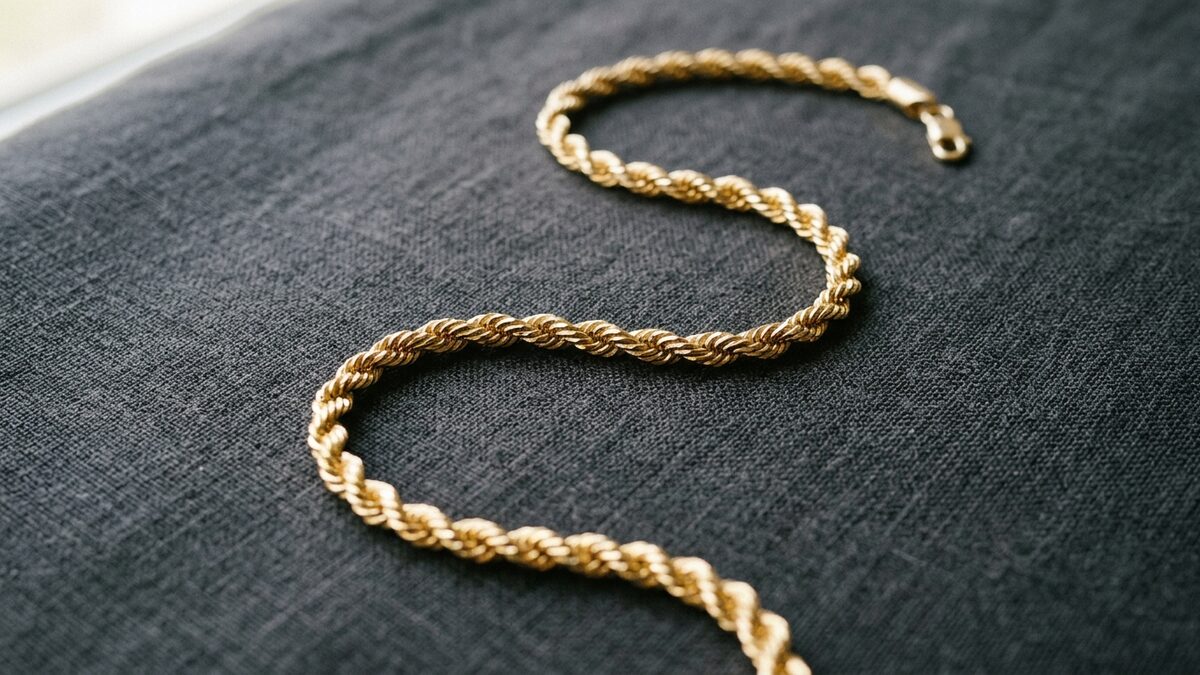
The rope chain is built from short, faceted links arranged in a tight spiral. Each segment is cut on multiple planes so that, when the helix turns under light, a different facet catches the eye every few millimeters. The chain does not shimmer the way a box chain does, and it does not flash the way a Cuban link does. It glints in a rolling pattern, which is what gives the rope its signature liveliness on the neck.
Two construction details govern the way a rope drapes. The first is pitch, the angle of the twist. A tighter pitch produces a denser, stiffer chain that holds its shape well but reads as more architectural. A looser pitch produces a softer, more fluid drape that follows the contours of the collarbone more readily. Most reputable workshops settle on a middle pitch that balances structure with movement, though heavier ropes are often wound tighter so they do not collapse under their own weight.
The second detail is whether the chain is solid or hollow. A solid rope is exactly what it sounds like: each link is formed from full-density wire. The chain has weight, it has presence, and it will outlast the wearer with reasonable care. A hollow rope is constructed from tube stock, giving the appearance of a heavier chain at a fraction of the gold content. Hollow ropes are not inherently lesser; they are simply built for a different purpose, and they require more careful handling because a sharp kink can crease the tube in a way that cannot be invisibly repaired.
How a Rope Chain Ages on the Neck
Worn daily, a rope chain develops a subtle character. The facets at the back of the neck, where the chain rotates most against skin and collar, soften first. This is not damage; it is the chain finding its quietest plane. The front segments, which see less friction, retain their original cut and continue to catch light cleanly. Over a long enough horizon, a well-made solid rope can look almost two-toned in its reflectivity, brightest at the front, mellower at the back, and that is part of why collectors prize older pieces.
The clasp area is where most rope chains eventually fail, and the failure is almost always preventable. A lobster or barrel clasp introduces a small zone of rigidity into an otherwise flexible chain. If the rope is repeatedly fastened while twisted, or if it is pulled off over the head rather than unclasped, the segments adjacent to the clasp begin to flatten and lose their facet geometry. Once that section flattens, the visual continuity of the helix breaks, and no amount of polishing restores it.
Solid rope chains also have a habit of revealing the quality of their construction in the first six months. A poorly soldered rope will begin to separate at one of the joins, often near the clasp end where tension is highest. A well-soldered rope, by contrast, will tighten slightly as the links settle, and the chain will hang straighter than it did the day it arrived. This settling period is normal and usually completes within a few weeks of regular wear.
Care That Actually Matters
The care routine for a rope chain is shorter than most owners assume. Three habits do almost all the work. First, unclasp the chain when taking it off; do not pull it over the head. The fastener exists for a reason, and using it preserves the segments near the clasp. Second, store the chain laid flat or hung, never coiled tightly. A coiled rope develops memory in its twist, and that memory shows on the neck as an uneven drape. Third, clean the chain gently with warm water and a soft brush when it dulls. The facets collect skin oils and lotion residue more readily than smoother chain styles, and a quick clean restores the light play without any aggressive polishing.
What to avoid is equally short. Avoid ultrasonic cleaners on hollow rope chains, as the vibration can stress the seams of the tube stock. Avoid sleeping in any rope chain, solid or hollow, because the twist of bedding can introduce kinks that no jeweler can fully reverse. Avoid wearing a rope chain in a pool or hot tub for long stretches; chlorine does not destroy gold, but it does dull the cut surfaces over time.
A rope chain that is bought thoughtfully and worn with a few small habits in mind will look, ten years on, exactly as it did the first afternoon it caught the light. That is the quiet promise of the construction, and it is the reason the rope continues to outlast trends that come and go around it.