
Singapore Chain vs Rope Chain: How Two Twisted Links Differ
Held up to a window, a Singapore chain and a rope chain can look like cousins: both throw light in quick, restless flashes, both fall in a soft coil, both feel alive against the wrist. The resemblance is real, but it ends at the surface. One earns its shimmer through a twisted weave of flat links; the other builds a spiral from clustered segments soldered into a continuous helix. Knowing which is which changes how you judge weight, drape, and how each will wear over the years.
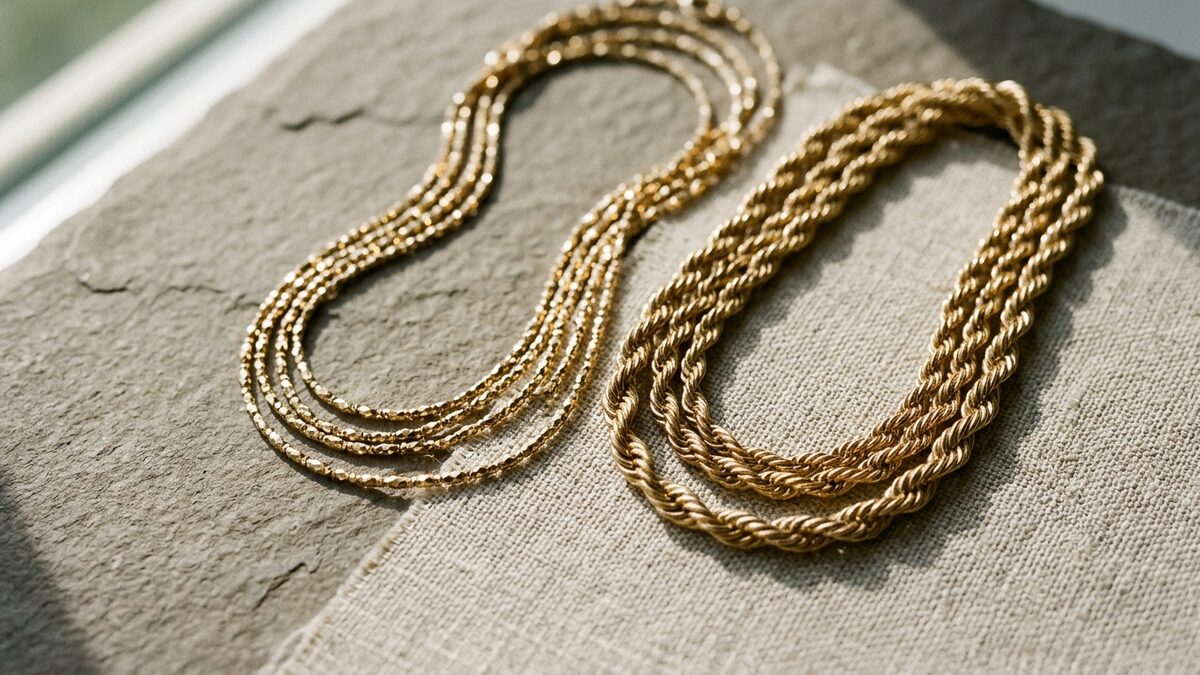
Start with what the eye sees, because that is where most people meet these two for the first time. A Singapore chain presents as a slim, faceted line that seems to ripple when it moves, a quality often described as a diamond-cut sparkle. A rope chain reads as fuller and more sculptural, with a visible twist running its length like the lay of an actual rope. Both catch light, but they do it from different starting points, and that difference traces directly back to how each is assembled.
The Singapore is, at heart, a curb chain that has been twisted. Its individual links are flattened and interlocked the way a standard curb link sits flush, then the whole length is given a turn so the links spiral around a central axis. That twist is what produces the kinetic flicker. Because the links are flat and diamond-cut, every facet meets the light at a slightly different angle as the chain shifts, so the sparkle moves rather than sitting still. It is a light, economical structure, which is why a Singapore tends to feel delicate even in higher karat gold.
How the rope chain builds its spiral from clustered segments
A rope chain works on an entirely different logic. Instead of one continuous twisted ribbon, it is composed of many small links arranged in clusters, usually grouped and soldered so they form short segments that wind around each other in a tight helix. Run a fingernail along its length and you can feel the spiral ridges, the same way you would feel the lay of a braided cord. That construction gives the rope its density and its characteristic depth: light does not just skim the surface, it falls into the grooves between the twists and bounces back out, which is why a good rope seems to glow from within rather than flash from the top.
This is also where durability enters the conversation. Rope chains come in two broad forms, solid and hollow. A solid rope is genuinely dense, with little air inside the structure, and it resists kinking and crushing well for its size. A hollow rope achieves the same visual fullness at a fraction of the weight by leaving the segments partly empty, which makes it lighter on the neck and gentler on a budget, but also more vulnerable to a dent or a snag that a solid version would shrug off. The Singapore, by contrast, is almost always made as a single twisted strand, so it has fewer solder points to fail but a thinner profile that can knot if it is handled carelessly.
Choosing between the two by drape, weight, and intended wear
Drape is the most honest test you can run in person. Lay both flat across an open palm and lift. A Singapore tends to pour, falling into a fine, fluid line that follows every contour, which makes it a natural companion for a small pendant or for wearing close to the skin where its slimness reads as refinement. A rope holds more of its own shape; it has body, and it sits with a gentle structure that supports a heavier pendant without disappearing under it. If you want a chain that announces itself as an object in its own right, the rope is the more confident choice. If you want a quiet line that flatters whatever hangs from it, the Singapore answers better.
Weight follows from construction. Because the Singapore is a thin twisted strand, a given length in the same karat will usually weigh less than a comparable rope, especially a solid one. That has practical consequences beyond comfort, since gold is sold by weight, so a substantial rope represents more material and will be priced accordingly. None of this makes one superior; it makes them suited to different intentions. A featherweight everyday piece and a sculptural statement length are answering different questions.
Consider, too, how each handles a lifetime of wear. The Singapore's flat, diamond-cut facets are responsible for its sparkle, and those facets are surface features, so years of contact with clothing and skin can soften them and dull the flash. The shape endures, but the original brilliance asks for occasional care to stay sharp. The rope's appeal lives in its geometry rather than its polish, so its look ages more gracefully; the spiral remains a spiral even as the metal develops the soft patina that many collectors prize. For a piece meant to be worn hard and often, that resilience is worth weighing.
One last way to separate them in hand: catch the light and watch the rhythm. The Singapore flickers fast and bright, a fine scatter of light that moves with the smallest motion. The rope answers slower and deeper, with light gathering along its ridges and releasing in a warmer, more continuous shine. Once you have seen the two side by side, you will rarely confuse them again, and the choice resolves itself into a simple question of which conversation you want the metal to have with the light, and with you.