
Snake Chain vs Herringbone Chain: How Two Flat Italian Classics Differ
Lay a snake chain and a herringbone chain next to each other on a velvet tray and the resemblance is immediate. Both are flat, both have an unbroken metallic surface, both originated in the small workshops of Vicenza and Arezzo. Pick them up, though, and the differences begin to declare themselves: weight, drape, the way light moves along the length. Understanding how each is built clarifies why one might suit a daily-wear collar and the other a layered evening look.
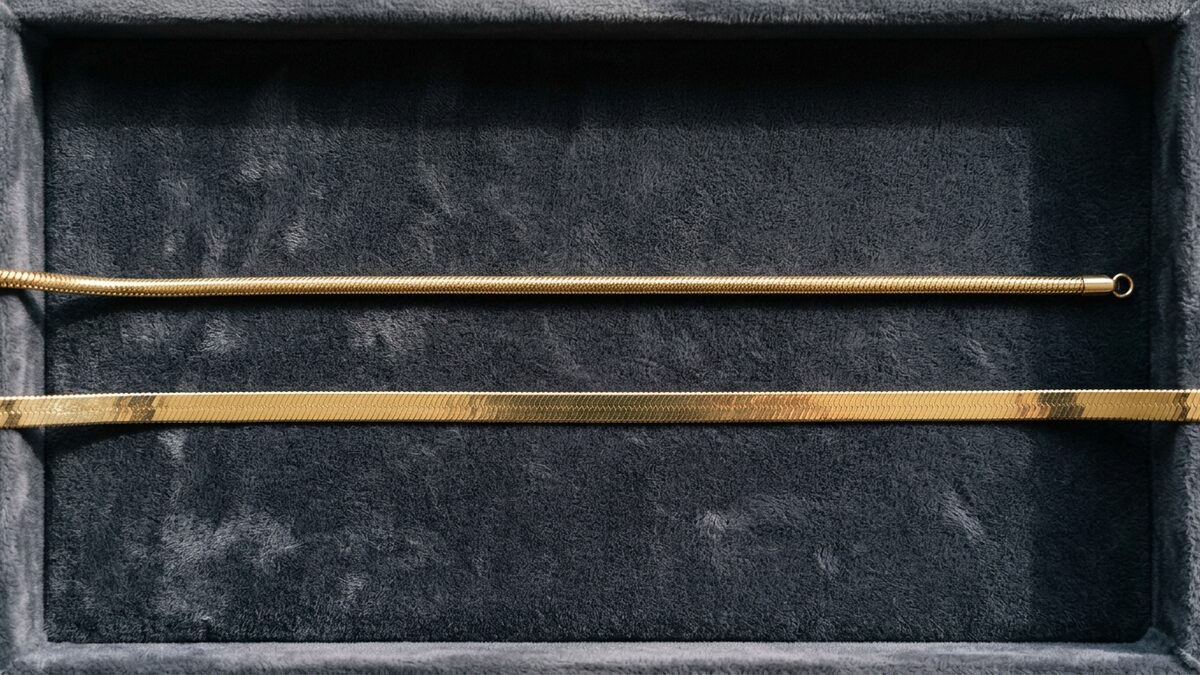
The snake chain is constructed from tightly interlocking wavy plates or rings, stacked so closely that the surface reads as a single round tube rather than a series of links. Run a fingernail along it and the texture is faintly ridged, like the scales the name suggests. Because each component nests into the next with very little play, the chain holds its cylindrical shape under tension and resists the lateral folding that flat chains are prone to. It is a quiet, structural piece, often produced in 1mm to 3mm diameters, and reads as a clean line on the neck rather than a decorative statement.
The herringbone, by contrast, is built from short, slanted parallel links arranged in a flat zigzag that mirrors the woven pattern its name refers to. The result is a ribbon, not a tube. Held flat, a herringbone catches light across its entire width at once, producing the high-mirror reflectivity that makes it a recurring favorite in editorial photography. The price for that flash is fragility: the parallel link structure has a single failure mode, a kink, and once a herringbone has been folded sharply against itself, the affected segment rarely lies flat again. Skilled jewelers can sometimes coax a mild kink back into alignment, but a deep crease is generally permanent.
How each style behaves in daily wear
Drape is where the practical difference becomes obvious. A snake chain falls with a slight stiffness, holding a gentle curve around the neck and tending to recover its shape after the wearer moves. It tolerates being slept in, tucked under collars, and stuffed briefly into a pocket without complaint. For someone who wants a precious-metal chain that disappears into a daily routine, the snake is forgiving in a way that few other flat styles are.
A herringbone wants more attention. It drapes beautifully when allowed to lie flat against the skin or a garment, but it does not respond well to being twisted, balled up, or hung on a hook that lets it spin. Storing a herringbone flat in a soft pouch, ideally rolled rather than folded, dramatically extends its working life. Many owners reserve the style for occasions and pair it with a sturdier everyday chain for ordinary wear. That two-chain rotation is a quiet hallmark of the more experienced collector.
Light behavior is the other axis of comparison. The snake reflects in a continuous, even gleam, almost satin in finer gauges and more pronounced in heavier ones. The herringbone, because its surface is genuinely flat, produces a brighter, more concentrated flash, particularly when the wearer moves under directional light. Photographers tend to favor herringbone for this reason, while stylists who want a piece that recedes into an outfit often reach for snake.
Choosing between them
Neither chain is inherently superior; the choice is a matter of intended use and tolerance for care. A buyer looking for one chain to wear daily, with minimal anxiety about handling, is generally better served by a snake in a moderate gauge. A buyer building a layered set, or seeking a single dramatic piece for evening, will find the herringbone offers a visual presence that few other flat styles can match. Many collections eventually include both, in different lengths, used for different registers of dress.
Gauge matters in both cases. A snake under 1.5mm reads as delicate and feminine; above 2.5mm it becomes a statement collar. A herringbone under 4mm is graceful and easily layered; above 6mm it becomes the centerpiece of a look and should generally be worn alone. The Italian mills that produce both styles offer a wide gauge range precisely because the visual effect shifts so dramatically with width.
A final note on construction quality: both styles benefit substantially from solid rather than hollow manufacture. Hollow versions of either chain are lighter and less expensive, but they kink and dent more readily and cannot be repaired in the same way. When evaluating a piece, the weight relative to length is the most reliable indicator, and a reputable jeweler will disclose hollow versus solid construction without prompting.