
Wheat Chain vs. Rope Chain: A Wholesale Buyer's Comparison
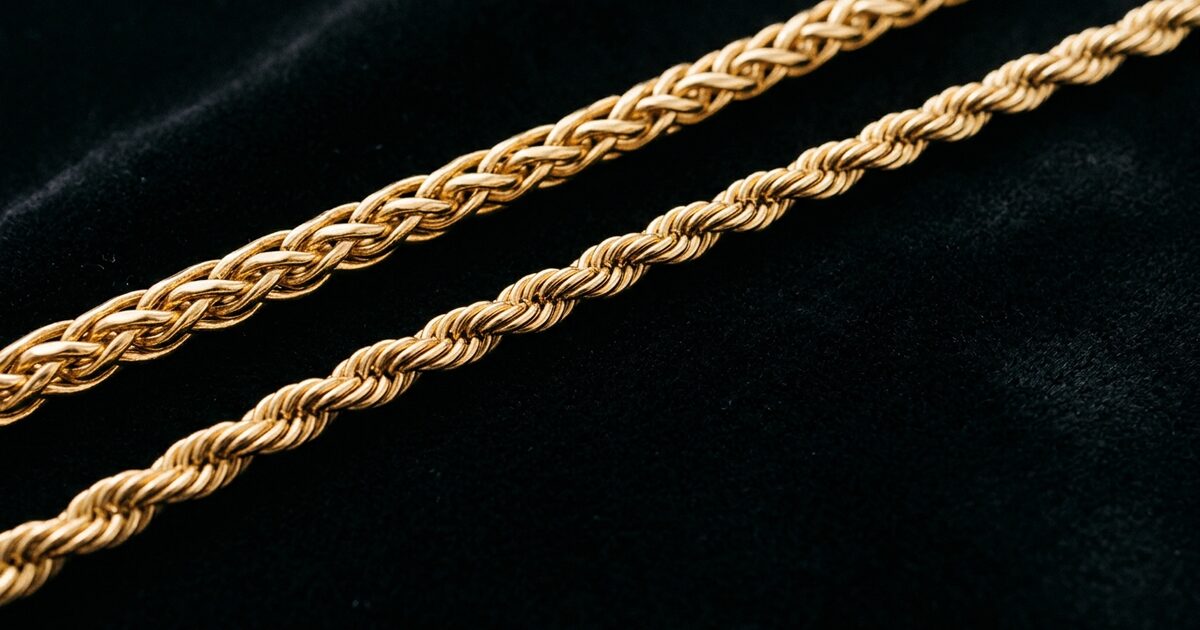
Wheat and rope chains occupy similar price points and sell to overlapping customers — but they are different products with different construction logic, different wear behavior, and different display-case stories. Here is the practical breakdown for wholesale buyers deciding which to stock, in what width, at what price point.
Construction: what you are actually looking at
A wheat chain — also called a spiga chain — is built from four strands of oval links twisted together and pressed flat. The result is a herringbone-like surface texture that catches light in a chevron pattern. The links are tight, the profile is relatively flat, and the chain drapes in a smooth, consistent curve. At small widths (1.5–2.5mm), wheat chains are one of the most elegant fine jewelry constructions available. At larger widths (3.5mm and above), the geometric surface pattern becomes the visual statement.
A rope chain is built differently: two or more groups of oval links twisted helically around each other and compressed during fabrication. The helical twist creates the signature spiral surface that catches and redistributes light along the length of the chain. Rope chains drape with a slight stiffness at narrower widths and become more fluid as width and weight increase. The construction makes rope chains among the most durable chain styles at comparable weights.
Both constructions are available in 14K solid and hollow variants. Both are commonly made in Italy and Turkey. Both can be produced in yellow, white, and rose gold.
Weight and cost math at equivalent widths
At the same stated width, rope and wheat chains typically differ in grams per inch. Rope chains, because of the helical compression, tend to run slightly heavier per inch than wheat chains at widths under 3mm. At 3–5mm, the gap widens — rope chains in this range are substantially heavier because the twist construction requires more metal to fill the stated profile than the pressed-flat wheat construction does.
The practical implication: a 3mm rope chain and a 3mm wheat chain of the same length will have different wholesale costs even if the supplier quotes them at the same markup rate, because the metal content differs. If you are comparing quotes from two suppliers, verify the gram weight per 18-inch length before concluding that one is cheaper than the other.
Quick check: Any supplier who cannot tell you the gram weight of a specific chain by length is pricing by visual category, not by metal content. Ask for the weight before committing to a wholesale order at any scale.
Durability and wear behavior
Rope chains are among the most durable chain constructions in the market. The helical twist distributes stress across multiple link contact points simultaneously, which means the chain can absorb lateral stress without failing at a single link junction. A rope chain that has been twisted, snagged, or pulled will typically spring back. It is not indestructible — clasp loads and sharp kinked bends are still failure points — but for everyday wear, rope chains outperform most other constructions of comparable weight.
Wheat chains are more delicate. The pressed flat construction that gives them their visual elegance also concentrates stress at the link junctions when the chain bends laterally. At narrow widths (under 2mm), wheat chains should be positioned as occasional-wear pieces, not everyday wear — particularly for customers with active lifestyles or who tend to sleep in their jewelry. At wider widths, the additional construction mass improves durability significantly.
Return data tracks this: rope chains in solid construction return at very low rates across wear categories. Wheat chains in narrow widths return at higher rates from customers who wear them daily. The fix is not avoiding wheat chains — it is being deliberate about the sell story and the width-width you recommend to the customer.
Display behavior and customer sell story
Rope chains are easy to sell. The helical surface is visually active — it catches light from multiple angles simultaneously, which makes it look lively on a velvet display tray and on the wrist. Customers can see the construction without picking it up. The chain reads as substantial and well-made because the construction is visible.
Wheat chains require a slightly different approach. The flat herringbone surface is more subtle on a display tray — it needs good lighting to show its best quality. Once a customer picks it up, the drape and lightness usually sell themselves. But the initial pickup often needs prompting in a busy retail environment.
The customer segments also differ slightly. Rope chain buyers tend to skew male and tend to want visible chain presence — the chain itself is the statement. Wheat chain buyers tend to skew female, and more often want something that works as a chain carrier for a pendant rather than as a standalone piece. Both generalizations have exceptions, but they are useful starting points for assortment planning.
Which width range to prioritize in each style
- Wheat chain, 1.5–2.5mm: The sweet spot — elegant enough for fine jewelry positioning, light enough to serve as a pendant carrier, price point accessible enough to be an entry purchase. Keep this in your core assortment.
- Wheat chain, 3mm and above: Statement assortment — lower velocity but higher average ticket. Customers who know what they want. Stock lightly, reorder on signal.
- Rope chain, 2–3.5mm: The highest-velocity range for rope in most retail environments. Wide customer fit, price point accessible across demographics, durable enough for everyday wear. This is the category you do not want to run out of.
- Rope chain, 4mm and above: Statement pieces with strong male-skew demand. Higher gold content means higher wholesale cost and higher retail ticket. Strong at gift occasions and in markets with higher average income.
Stocking both: the assortment case
Wheat and rope serve the same customer in different moods, not different customers entirely. A buyer who wants a pendant carrier for a religious medallion might choose wheat for its flat profile under a shirt. The same buyer, looking for a second chain to wear with a heavier piece, might choose rope for its visibility. Stocking both at their respective optimal widths gives you the coverage to serve that customer across occasions.
OroJoy carries both wheat and rope chains in 14K solid construction across the core width range. All listings show gram weight by length and current wholesale price against 14K spot. Contact the trade desk if you want to compare specific specs side by side before placing an order.